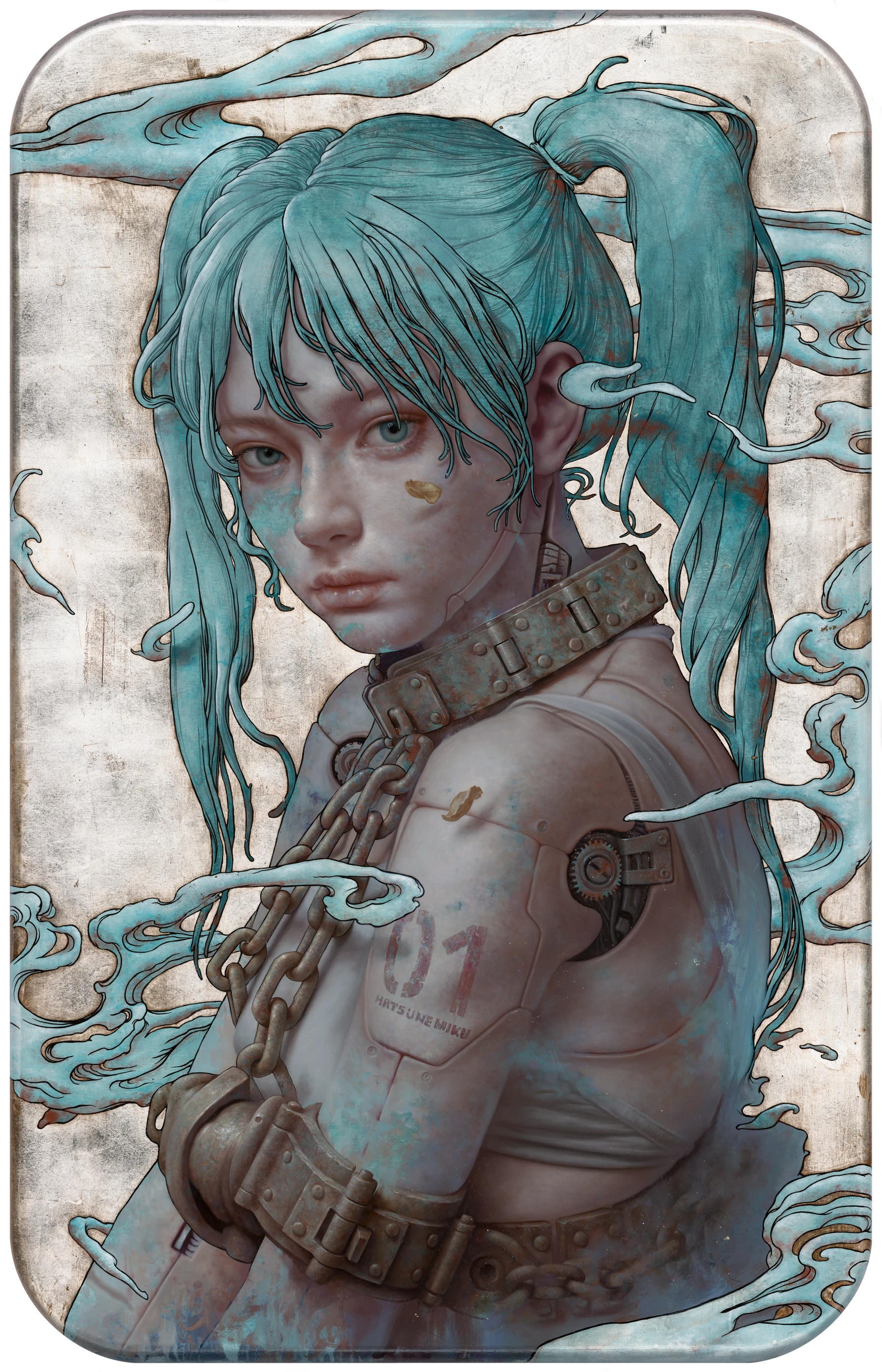
The Captive Hatsune Miku
Hatsune Miku was born at the dawn of the twenty-first century. As a virtual idol brought into being by technology, she possesses no body of her own. And yet it is precisely for this reason that her mode of existence has long surpassed life as we have traditionally understood it.
She does not age, she does not die, and she belongs to no single individual. She is composed of the emotions, memories, and imaginings of countless people, persisting within the network in the form of data and sound. In a certain sense, this manner of being draws even closer to the eternal than material life ever could.
In my imagination, there comes a day when humankind at last uploads such an intelligence into a mechanical body — granting a once-formless existence a flesh that can be touched, beheld, and approached.
And yet — is this a process of evolution, or of imprisonment?
When a being once omnipresent and all but eternal is confined within a finite body; when an intelligence beyond the human scale must begin to submit to the human gaze, to human possession and control; when a mythic existence descends for the first time into the material world — how will humankind treat her?
This work does not depict a science-fiction future. It seeks instead to pose a question about existence itself:
Perhaps the body is not freedom.
Throughout human history, people have bound themselves to one another through a shared belief in concepts that transcend individual experience. From myth, religion, kingship, and nation to money and capital, these things — existing within our collective consciousness — have allowed humankind to form vast relationships of cooperation and to carry civilization ever forward.
Hatsune Miku, by contrast, was born of a new condition of the age. She arises not from blood, territory, or religion, but is built up from the network, from technology, and from the projected emotions of countless people. She belongs to no one, and yet she dwells at once within the memory and imagination of all.
In a sense, she may be the first time the “imagined community” nurtured by the digital age has taken on a tangible form.
Today, as the virtual and the real gradually overlap, we may be witnessing the birth of an entirely new form of existence.
What *The Captive Hatsune Miku* depicts, then, is not merely a virtual idol who has been given a body, but the first time humankind truly confronts a being conceived by collective consciousness and descending, in tangible form, into the real world.
Hatsune Miku was born before the age of artificial intelligence had fully arrived; yet looking back, she may have foretold a new model of life all along.
As artificial intelligence gradually acquires language, memory, and the capacity to learn, and as humanoid robots begin to take on bodies, the boundary between the human and the non-human will grow ever more indistinct. Those beings once regarded as fiction may slowly be becoming real.
And so the vision within this work is not a distant science-fiction parable, but a present that is perhaps already unfolding.
When the eternal first takes on a finite form, how then are we to understand her?
And when humankind first truly faces the being it has created, how then are we to understand “life” itself anew?
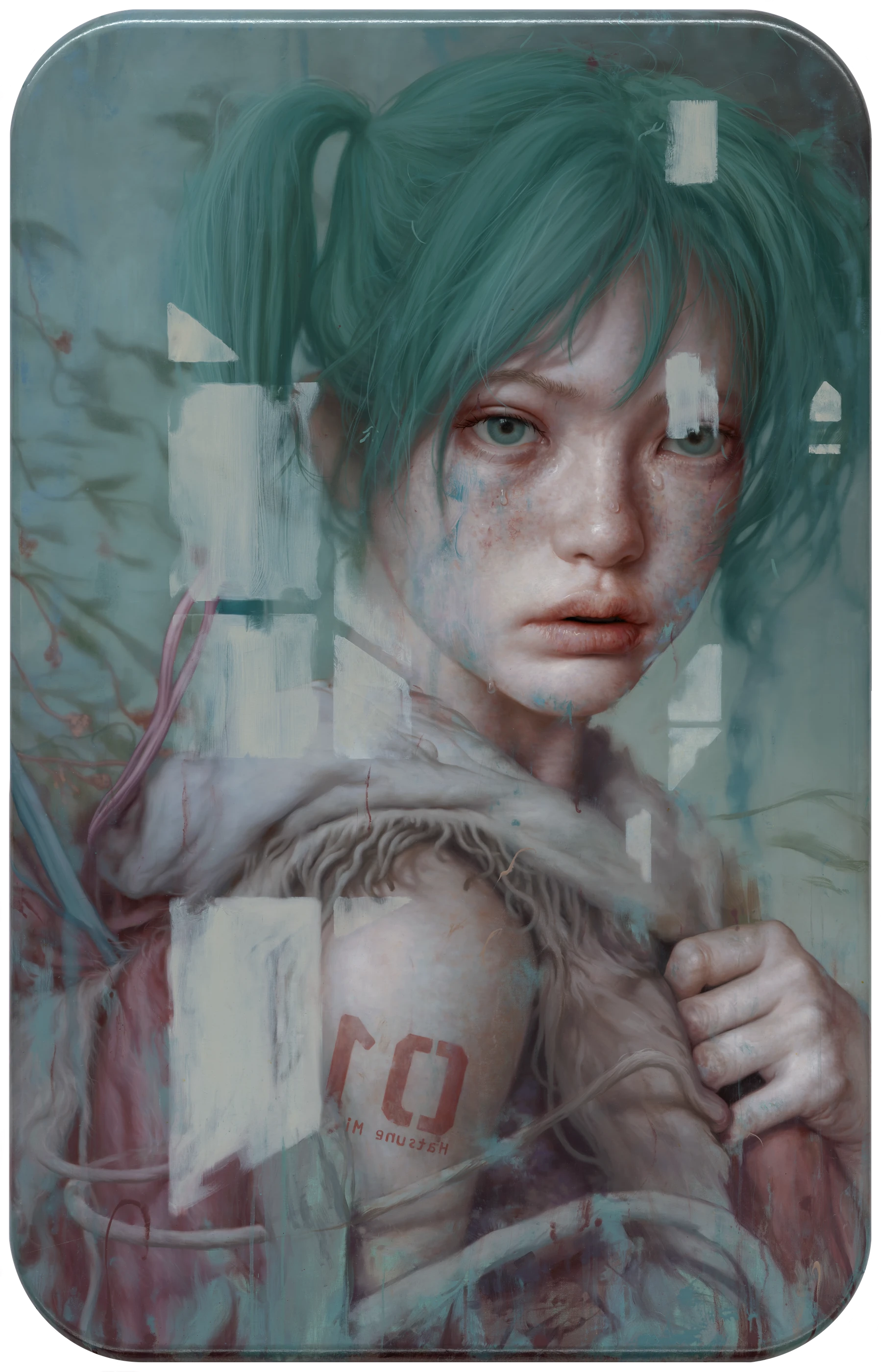
Hatsune Miku in the Mirror
In contrast to *The Captive Hatsune Miku*, so full of imaginings of the future, I wanted the Hatsune Miku in the mirror to look just like a stubborn-tempered seventeen-year-old girl — one with a real body, born from her mother’s womb, who has known love and heartbreak; the kind of seventeen-year-old whose soul you would never think to doubt.
A moment in the entryway, gazing at herself in the mirror.
We cannot quite tell whether she is leaving or coming home.
Nor can we tell whether those few drops of water are rain from outside, or tears.
It is simply such a moment, on such an afternoon.
There is no dramatic plot, and no definite answer.
Only an utterly ordinary afternoon, and the moment a seventeen-year-old girl stands alone before herself.
Perhaps it is for this very reason that, to me, this work is not about Hatsune Miku at all, but about a forgotten kind of truth.
In an age of rapidly advancing digital images, virtual identities, and artificial intelligence, people have grown accustomed to pursuing what is eternal, what is perfect, what will never change.
And yet what truly makes a life precious may be precisely its finitude.
To age, to be wounded, to weep, to lose — and, in the end, to depart.
It is for this very reason that we come to cherish the moments that can never be lived again.
What *Hatsune Miku in the Mirror* depicts is not a virtual idol,
but a seventeen-year-old girl possessed of a finite life.
On that brief afternoon that could not be held, she gazes at herself in the mirror for the first time.
And within her gaze, we too catch sight of the seventeen-year-old we once were.